
Sunken driveways, tilted walkways, and uneven patio slabs are more than cosmetic problems. They create trip hazards, let water collect near your foundation, and can lead to costly replacement if left alone. At Georgia Insulation in Monroe, GA, we offer concrete lifting for homeowners and business owners who want to correct settled slabs without tearing out and repouring them.
Concrete lifting raises sunken slabs back to their original level by injecting a lightweight material beneath the concrete, usually in a single visit and with little disruption to your property. The process uses small injection holes, so the surface stays intact and most slabs can be used again shortly after the work is done.
We serve Monroe and the surrounding communities, and we apply the same approach to residential driveways, sidewalks, pool decks, garage floors, and commercial parking areas and walkways. This page explains where concrete lifting is used, what it offers over replacement, and how our process works, so you can decide whether it fits your property.
Two-part polyurethane foam is injected through small ports, expands into voids, and lifts the slab in controlled increments. The method suits many settled slabs, but it works differently from insulation foam and does not fit every situation.
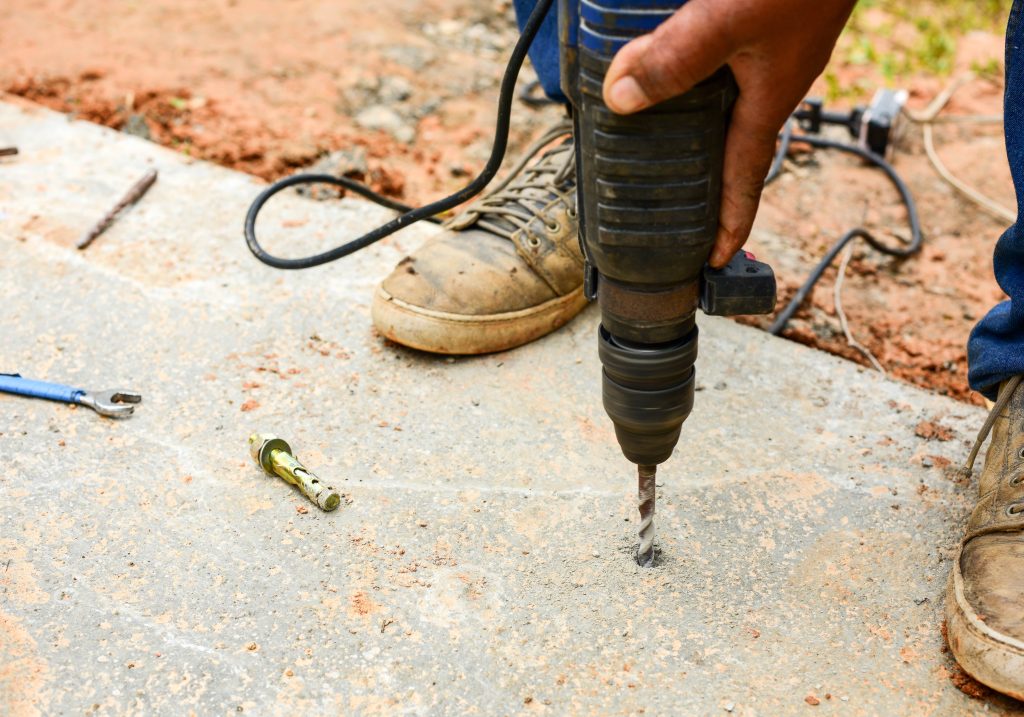
Our crew drills holes about the size of a dime, usually 5/8 inch, through the settled slab. We then inject a liquid polyurethane resin through those ports into the void and soft soil underneath.
The resin mixes at the injection gun, reacts within seconds, and expands into a rigid foam. The foam fills the empty space first. Once the void is full, continued expansion creates upward pressure that raises the slab.
We lift in small increments and watch the slab with a laser level or a straightedge. This lets us stop when the concrete reaches the right height, often within about 1/8 inch of the target. After lifting, we patch the ports with grout so the surface looks clean.
Most slabs can be driven on within about 15 minutes of the final injection, though we confirm timing for each job.
Get a Free QuoteBoth services use polyurethane chemistry, but the products and goals are different. Lifting foam is a dense, high-compressive-strength material made to carry loads. Spray foam insulation is a lighter foam made to control heat and air movement.
| Feature | Concrete Lifting Foam | Spray Foam Insulation |
|---|---|---|
| Purpose | Fill voids and raise slabs | Insulate and air seal |
| Density | High, load-bearing | Lower, not made for loads |
| Application | Injected under slabs | Sprayed on walls, attics, and floors |
| Typical location | Driveways, patios, garage floors, warehouse floors | Wall cavities, roof decks, crawl spaces |
We do not use insulation foam to lift concrete, and we do not use lifting foam to insulate a building. Each product is selected for the job it was formulated to do.
Get a Free QuoteLifting works best when the slab is still structurally sound. A slab with minor cracking that has simply sunk or tilted is often a good candidate.
Lifting is usually a good fit when:
Replacement is usually the better choice when:
We inspect the slab and the likely cause of settlement before recommending either option, so the repair matches the condition you actually have.
Get a Free QuoteConcrete that has settled, tilted, or developed uneven edges can usually be raised back to grade, whether it sits at a home’s front door or a store’s entrance. We lift most poured slabs, from driveways to commercial pedestrian paths, by injecting material beneath them rather than replacing them.
Driveways and walkways are the surfaces we level most often in Monroe and the surrounding areas. Georgia’s clay soils shrink and swell with moisture, which leaves voids under slabs and causes panels to sink or tilt.
Common problems we correct include:
Walkway edges that differ by even half an inch can catch a foot, so we measure the height difference before we start. Steps and landings are lifted as a unit, which keeps their position correct relative to the doorway.
Interior and backyard slabs settle for the same reasons as driveways, but the consequences differ. A sunken garage floor can pool water, stress the door seal, and make it harder to roll equipment across the floor.
Patios often tilt toward the house, which sends rainwater against the foundation or into a crawlspace vent. Pool decks need extra care because a low section can hold standing water and a gap between the deck and pool shell can widen over time.
Area | Typical problem | What leveling addresses |
Garage floor | Uneven or sunken sections | Restores a flat surface and proper drainage |
Patio | Slope toward the house | Redirects water away from the structure |
Pool deck | Low spots and widening gaps | Reduces standing water and trip points |
We check each slab for cracks first, since a slab that has broken into many pieces may be better replaced than lifted.
Business owners face a different concern: liability. An uneven entrance, loading area, or sidewalk can lead to a customer or employee injury, and fixing the surface quickly matters.
We level concrete at storefront entrances, parking lot walkways, loading dock approaches, warehouse floors, and the paths that connect buildings. Because the work is done with a small injection footprint, most areas can be used again soon after we finish. That limits disruption to foot traffic and deliveries.
Property managers can ask us to survey several locations at once, which helps when multiple sidewalks or entrances show settling. We note which areas are the highest priority, such as raised edges in high-traffic paths, so you can schedule the most urgent repairs first.
Lifting sunken slabs back to their original grade reduces tripping risks, avoids the cost and mess of tearing out concrete, and brings walkways, driveways, and floors back into line with the surrounding surfaces. Each result is something you can see and measure once the work is done.
A raised edge as small as half an inch between two slabs can catch a toe or a shoe. Sidewalks, porch landings, driveway aprons, and garage entries are common places where this happens. When we lift a settled slab to meet its neighbor, the lip disappears and the walking surface becomes continuous again.
This matters for everyone who uses the space. Children, older adults, and people who use walkers or wheelchairs benefit most from level paths. Delivery drivers and customers at commercial properties also cross these areas daily.
Lifting also changes how water moves. Sunken slabs often tilt toward a building, which sends runoff toward the foundation. Restoring the slope helps water drain away from the structure and reduces standing water that can freeze and create slick patches.
Replacing a slab means breaking out the old concrete, hauling away debris, preparing the base, and waiting for new concrete to cure. That process can take several days and leaves the area unusable for a week or more. Lifting is a much shorter job.
Here is how the two approaches compare:
Factor | Concrete Lifting | Slab Replacement |
Typical work time | A few hours for most projects | Multiple days |
Heavy equipment | Compact equipment | Breakers, hauling trucks, mixers |
Downtime after work | Often light use soon after | Several days to a week or more |
Debris removal | Minimal | Large volumes of broken concrete |
Landscape impact | Small injection holes | Often damaged lawns and plantings |
Because the original slab stays in place, you avoid dumpster rentals and torn-up yards. Business owners can also keep entrances and parking areas open for most of the day.
Lifting generally costs less than replacement, although the price depends on slab size and how far the concrete has settled.
Settled concrete creates visible gaps, uneven seams, and slopes that make a property look neglected. Raising the slabs closes those gaps and returns joints to a consistent height, which gives driveways, patios, and walkways a clean, uniform look.
Keeping the existing concrete also means the color and texture stay consistent. New slabs poured next to older ones rarely match, because weathering changes the shade over time. Lifting avoids that mismatch entirely.
Aligned surfaces are also easier to maintain. Snow shovels, lawn equipment, and wheeled carts move across level joints without catching. Sealing and cleaning are simpler when water does not collect in low spots.
For homeowners preparing to sell and for businesses that want a professional entrance, level concrete supports a better first impression without the expense of a full rebuild.
A slab that has dropped even half an inch can injure people, let water collect against your building, and crack further each season. The longer a settled slab stays in place, the more the surrounding soil weakens and the more it costs to correct.
A height difference of just ¼ to ½ inch between two slabs is enough to catch a shoe. Many municipalities treat a ½-inch vertical offset in a public sidewalk as a defect that needs repair.
At a home, the most common problem spots are front walks, porch steps, and driveway aprons. Children, older adults, and anyone carrying groceries or a package are the most likely to fall.
For business owners, the exposure is larger. A customer or employee who trips on an uneven entrance or parking lot walkway may file an injury claim, and the property owner can be held responsible when the defect was visible and left unrepaired.
Settled slabs also create problems beyond falls:
When a slab sinks, it often tilts toward a building instead of away from it. Rain then collects in the low spot or runs back toward your foundation, garage door, or entry.
Standing water seeps through joints and edges into the soil below. In the Monroe area, where clay soils swell when wet and shrink when dry, that moisture cycle keeps changing the ground under the slab. Water can also wash fine soil out from under the concrete, which leaves voids that grow with each storm.
Pooled water causes other problems at the surface:
A slab with a void beneath it has no support in that area. Weight from vehicles or foot traffic can then crack it more quickly.
Concrete is strong under compression but weak when it is not fully supported. Once the soil beneath a slab drops away, the slab bends under its own weight and the loads placed on it, and it cracks.
Those cracks let in more water. Water adds to the erosion underneath, which allows more settling, so the damage feeds on itself. A slab that could have been lifted back into place may eventually break into pieces that can only be removed and replaced.
The cost difference is often significant:
Repair stage | Typical approach |
Early settling, slab intact | Lifting and leveling in place |
Large voids, wide cracks | Lifting plus extensive void filling |
Broken or crumbled slab | Demolition, soil work, and new concrete |
Replacement also means days of curing, and it disrupts landscaping, entrances, and parking while the work is done.
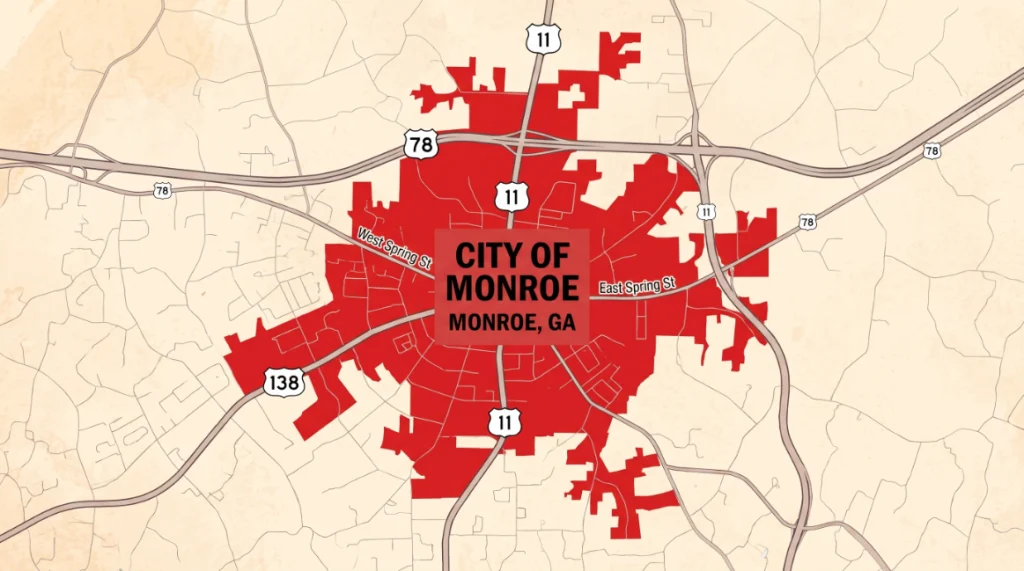
We work out of Monroe, GA, and we handle concrete lifting for homes and commercial properties across Walton County and the nearby area. Our process centers on clear scoping, straight answers about what the work can and cannot fix, and written estimates you can compare.
Based in Monroe, GA, we serve nearby communities including Loganville, Social Circle, Covington, Winder, Bethlehem, and Good Hope. Our local experience helps us address concrete settling caused by Georgia's shifting red clay soils, while providing convenient site visits, follow-up support, and recommendations that consider drainage conditions.
We tailor concrete lifting projects to the needs of homeowners and businesses, addressing trip hazards, drainage, curb appeal, accessibility, and uneven slabs. Our minimally invasive injection process helps preserve existing concrete and landscaping while allowing flexible scheduling to reduce disruption to customers, deliveries, and daily activities.
We begin with your property details and photos, followed by an on-site assessment to measure settling, inspect underlying voids, and identify possible causes. We then provide a written estimate outlining the repair scope, materials, timeline, and total cost, along with an honest recommendation on whether lifting or replacement is more suitable.
A typical lifting visit starts with a measured evaluation of the slab and the soil beneath it, moves to small-diameter drilling and staged foam injection, and ends with patched holes and clear guidance on when you can use the surface again. Most residential projects finish in a few hours, and we explain each step before work begins.
Before we lift anything, we need to know why the slab sank. We walk the property, measure elevation differences across the slab with a level or laser, and note cracks, gaps at joints, and areas where water pools.
We also look for the usual causes of settlement:
If voids are suspected, we probe the slab edges and sound the surface to find hollow areas.
Some problems need to be fixed first. A leaking pipe or a downspout that discharges beside a slab will undermine the repair if it continues. We tell you what we find and give you a written scope and price before any work starts.
Once the plan is set, we clean the slab and mark injection points, usually spaced a few feet apart. We drill holes about the size of a nickel, typically 5/8 inch, through the concrete. Because the holes are small, the slab stays intact.
We then inject high-density polyurethane foam through each port in stages. The foam expands, fills voids, and lifts the slab as it spreads beneath it.
Elevation is monitored during injection. We watch the slab with a level and adjust the injection order so the surface rises evenly rather than cracking from uneven pressure.
You can expect some noise from the drill and injection equipment. The process produces no excavation, no large machinery on your lawn, and no curing wait for fresh concrete.
When the slab reaches the target height, we stop injecting and remove the ports. We fill each hole with a cement-based patch and clean the surface of any residue or foam overspray.
We then recheck elevations across the slab and confirm that water drains away from the structure and that joints line up. We walk through the results with you and note any remaining cracks, which lifting does not seal.
Return-to-use timing is short:
Use | Typical timing |
Foot traffic | Immediately after patching |
Passenger vehicles | Generally within about 15 to 30 minutes after injection ends |
Heavy trucks or equipment | We advise on a case-by-case basis |
Patch color may differ slightly from the surrounding concrete until it weathers.
We provide professional concrete lifting services in Monroe, GA, and surrounding communities. Our team helps homeowners and businesses address sunken slabs, uneven walkways, and drainage issues with tailored solutions designed to restore stability and reduce further damage.
We offer inspections for properties throughout our service area. During this visit, we examine the affected concrete, assess the soil conditions beneath it, and identify the likely cause of settling or unevenness.
We recommend scheduling an evaluation as soon as you notice sinking or shifting concrete, since delays can allow the underlying soil issue to worsen.
Most questions we hear from Monroe-area property owners involve how the process works, which surfaces qualify, what it costs, and how long the repair holds up. The answers below cover those points for both homes and commercial properties.
We drill small holes, typically about the size of a dime, through the sunken slab. A high-density polyurethane foam is injected beneath the concrete through those holes. The foam expands, fills voids, and raises the slab back toward its original level.
Our crew monitors the slab during injection and stops once it reaches the correct height. The holes are then patched, leaving small marks that are barely visible.
We lift driveways, sidewalks, patios, pool decks, garage floors, porch slabs, and steps. Commercial properties often need work on parking lots, loading areas, walkways, and warehouse floors.
Slabs that are cracked but still in one piece usually respond well. Concrete that has crumbled or broken into many small pieces may need replacement instead, and we will tell you if that applies to your slab.
Pricing depends on the size of the area, how far the slab has sunk, and how much foam is needed to fill the voids underneath. A single sunken sidewalk panel costs less than a full driveway or a large commercial slab.
Concrete lifting generally costs less than tearing out and replacing concrete. We provide a free on-site estimate so you know the price before any work begins.
Yes. The same method works on residential slabs such as driveways and patios and on commercial surfaces such as parking areas, entrances, and warehouse floors.
For businesses, the short repair window matters. Work can often be completed with limited disruption to customers and staff, and lifting trip hazards also reduces liability exposure from uneven walkways.
The foam cures quickly. Foot traffic is usually fine within minutes of the work being finished, and vehicles can often use the surface within about 15 to 30 minutes.
We will give you specific guidance based on the slab and the conditions on the day of the job.
Polyurethane foam is water-resistant and does not wash out, so it holds up well in Georgia’s wet climate. Many installers report repairs lasting for decades when the underlying soil problem has been resolved.
If poor drainage or soil erosion caused the settling, we point that out so the cause can be corrected. Fixing water flow near the slab helps keep it from sinking again.