Commercial buildings in Marietta lose energy through walls, roofs, and crawl spaces every day. Georgia Insulation provides commercial insulation services that reduce energy waste, stabilize indoor temperatures, and protect your building’s structure. Poor insulation drives up utility costs and creates uncomfortable working conditions for employees and customers.
We serve business owners throughout Marietta and the surrounding areas with insulation solutions built for commercial properties. Our team understands that offices, warehouses, and retail spaces each have different insulation needs based on their layout and use.
This page covers our commercial insulation services, the risks of skipping proper insulation, and what our process looks like from start to finish. We also answer common questions business owners ask before starting a project.
Every commercial building has distinct zones that require different insulation approaches. We assess each area separately to determine the right foam type, thickness, and application method for your structure.
Roof decks and attics account for a significant portion of heat gain and loss in commercial buildings.
We apply closed-cell spray foam directly to the underside of roof decks, creating a continuous air barrier that resists moisture and adds structural rigidity.
For open attic spaces without ductwork, open-cell foam is often a more cost-effective option. Our team evaluates roof pitch, ventilation, and moisture exposure before recommending a product.
Key considerations we address:
Wall assemblies present different challenges depending on construction type and accessibility.
For new construction or open-wall retrofits, we spray foam directly into stud cavities, filling gaps around outlets, framing, and utility penetrations.
In existing buildings with finished walls, we use injection foam techniques that introduce insulation through small drilled holes while minimizing disruption to interior finishes.
Interior partition walls between conditioned and unconditioned spaces can also benefit from foam application to reduce noise transfer and stabilize temperatures.
GET A FREE QUOTECrawl spaces and mechanical rooms are often overlooked, yet they directly affect indoor air quality and equipment performance.
We apply closed-cell foam to crawl space walls and rim joists to block moisture intrusion and reduce the risk of mold growth.
In mechanical areas, foam insulation helps stabilize temperatures and reduce condensation on pipes and ductwork.
We also coordinate with facilities teams to ensure access panels, shut-off valves, and service points remain functional after installation.
GET A FREE QUOTEA properly insulated commercial building affects three core areas: energy costs, occupant comfort, and moisture control. Each of these factors directly influences your operating budget and the long-term condition of your property.
Spray foam insulation reduces the amount of energy your HVAC system needs to maintain a stable indoor temperature. When conditioned air stays inside instead of escaping through walls, roofs, or gaps, your equipment runs less often and for shorter cycles.
This translates into lower monthly utility bills. It also reduces wear on your HVAC system, which can extend its service life and delay costly replacements.
We size and install insulation based on your building’s specific layout, so you get coverage where it matters most. Areas like roof decks, wall cavities, and rim joists tend to have the highest energy loss without proper insulation.
Over time, these savings add up and support a more predictable operating budget.
Uneven temperatures across a building are often a sign of gaps in the envelope. Some rooms may feel too cold in winter or too warm in summer, even when the thermostat hasn’t changed.
Spray foam creates a consistent thermal barrier that helps stabilize temperatures room to room. This matters for tenant satisfaction, employee productivity, and customer experience in retail or office spaces.
We pay close attention to areas prone to temperature swings, including:
Addressing these zones helps create a more balanced indoor environment throughout the year.
Air leaks and moisture intrusion can lead to mold growth, material decay, and poor indoor air quality. Spray foam forms a continuous seal that limits both air movement and water vapor penetration.
This is particularly important in Georgia’s humid climate, where moisture buildup can compromise insulation performance and structural materials over time. A well-sealed envelope reduces the risk of condensation forming inside walls or ceilings.
We assess your building for common trouble spots, such as:
Area | Common Issue |
Roof penetrations | Air and water infiltration |
Wall-to-foundation joints | Moisture intrusion |
Window and door seals | Air leakage |
Sealing these areas protects your building’s structural integrity and supports better long-term air quality for occupants.
Postponing insulation improvements does not stop existing problems; it allows them to compound. The longer a building operates with inadequate insulation, the more it costs in energy, repairs, and equipment wear.
Heating and cooling account for a large share of most commercial energy bills. Without proper insulation, conditioned air escapes through walls, roofs, and gaps, forcing HVAC systems to run longer to maintain set temperatures.
We often see business owners underestimate how much this adds up over a year. A poorly insulated building can waste 20-30% more energy than one with proper insulation in place.
These losses show up as:
The cost does not stay flat, either. As energy rates rise, so does the financial impact of poor insulation, making early upgrades more valuable over time.
Gaps in insulation create temperature differences between interior and exterior surfaces. This temperature imbalance leads to condensation, particularly in walls, ceilings, and around windows.
Moisture buildup does not stay isolated. Over time, it can lead to:
We recommend addressing insulation gaps before moisture problems appear, since drywall repairs, mold remediation, and structural fixes cost significantly more than an insulation upgrade. Left unresolved, moisture damage can also affect tenant health and satisfaction, which carries its own financial risk for property owners.
Insulation gaps do not just raise costs; they create inconsistent indoor temperatures. Some rooms may feel too warm, while others stay cold, regardless of thermostat settings.
This forces HVAC systems to work harder and cycle more frequently to compensate. We commonly see this extra strain lead to:
Issue | Result |
Frequent cycling | Faster equipment wear |
Overworked components | Higher repair frequency |
Reduced lifespan | Earlier system replacement |
A system under constant stress typically needs replacement sooner than one operating under normal conditions. Delaying insulation upgrades, in this case, shifts costs from a manageable investment to a larger capital expense down the line.
Business owners across Marietta rely on us for insulation work that meets commercial building codes and holds up under daily operational demands. Our approach combines technical expertise, quality materials, and straightforward recommendations tailored to your property.
We work specifically with commercial properties, not just residential jobs adapted for larger spaces. This means we understand the unique requirements of warehouses, retail buildings, office complexes, and industrial facilities. Commercial insulation projects involve different considerations than residential work, including building codes, HVAC load calculations, and fire safety ratings, all of which factor into our recommendations. Our team has experience working with multi-story office buildings, warehouses and distribution centers, retail and restaurant spaces, and industrial facilities with specialized ventilation needs. We assess each property based on its actual use, occupancy patterns, and existing infrastructure, recognizing that a distribution warehouse has different insulation needs than a customer-facing retail store and accounting for those differences throughout our planning.

We use spray foam products rated for commercial applications, selected based on R-value requirements and the specific area being insulated. Material choice affects long-term performance, so we match products to your building's structure and climate exposure. Our installation teams follow manufacturer specifications and industry standards for application thickness and coverage. Improper installation can reduce insulation effectiveness even with high-quality materials, so we prioritize correct technique alongside product selection. We inspect completed work before considering a project finished. This includes checking for gaps, verifying coverage in hard-to-reach areas like rooflines and crawl spaces, and confirming the installation meets the specifications outlined in your project plan.
We provide assessments based on your building's actual condition, not generic packages. Before starting work, we evaluate your current insulation levels, identify problem areas in areas such as the attic, walls, and crawl spaces, and explain what we find in plain terms. When applicable, we use thermal imaging to identify areas of energy loss and consider building-specific factors such as occupancy type, HVAC systems, and square footage. We outline the reasoning behind each recommendation, including expected costs and the areas where insulation improvements can have the most impact, allowing you to make decisions based on your budget and priorities rather than a one-size-fits-all proposal.
Every commercial insulation project follows a structured path from initial inspection to completed work. We assess your building’s specific needs, plan the scope accordingly, and install materials with attention to detail and cleanliness.
We start by inspecting your commercial property in person. This includes checking existing insulation levels, identifying air leaks, and examining areas like the roof, walls, and HVAC ductwork.
We also look for moisture issues, gaps around penetrations, and any code compliance concerns specific to Marietta and surrounding areas. Our team documents findings with photos and notes.
This evaluation gives us a clear picture of your building’s current performance. It also helps us identify which insulation type and application method will work best for your space, whether that’s spray foam, batt, or blown-in material.
Based on our assessment, we put together a project plan specific to your building. This includes:
We work around your schedule to minimize disruption. If you operate during standard business hours, we can plan installation for evenings, weekends, or slower periods depending on your preference.
We also account for any permits or inspections required for your project. Once you approve the scope, we confirm a start date and provide a written timeline.
Our crews apply insulation according to the plan, using proper safety equipment and application techniques suited to the material. For spray foam, this means controlling temperature and thickness during application to meet R-value requirements.
We protect surrounding areas, including flooring, equipment, and furniture, before work begins. Once installation is complete, we remove debris, packaging, and any leftover materials from the site.
We also do a final walkthrough with you to confirm the work meets the agreed-upon scope. This gives you the chance to ask questions or point out any areas needing attention before we consider the job finished.
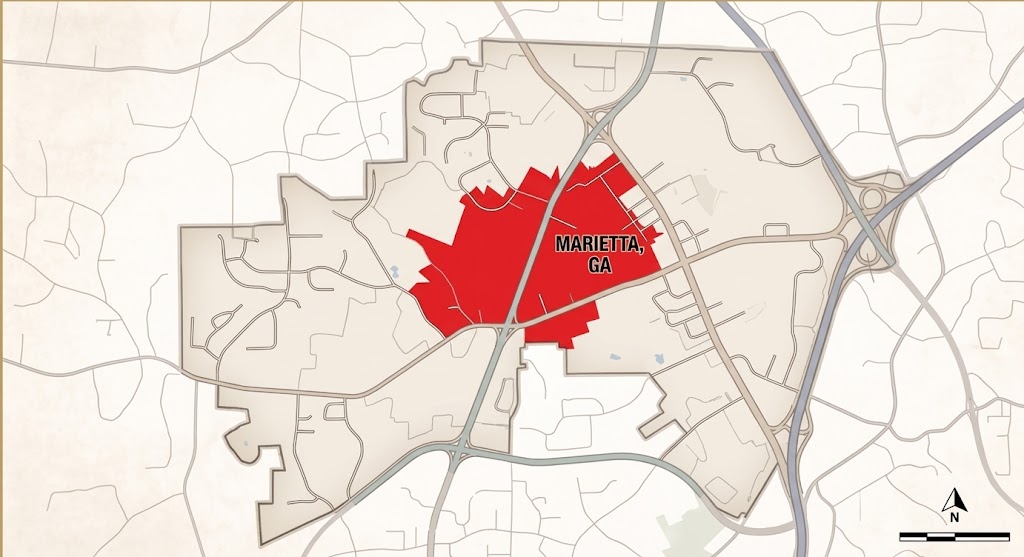
Georgia Insulation works with commercial property owners throughout Marietta and the greater metro Atlanta area. We understand the regional climate and the building codes that apply to commercial structures in each community we serve.
We provide free estimates for commercial insulation projects throughout our service area. Contact us to schedule an on-site assessment of your property.
During the estimate visit, we evaluate your building’s current insulation condition and identify areas that need attention. We then provide a written quote outlining the recommended work, materials, and cost.
Call our office or fill out our online request form to get started. We respond to estimate requests promptly and work with your schedule to minimize disruption to business operations.
Business owners considering commercial insulation often have questions about material choices, R-values, timelines, and cost savings before moving forward. Below we answer the questions we hear most often from Marietta and metro Atlanta property owners.
The right insulation type depends on your building’s structure, use, and existing framework. We commonly recommend spray foam, blown-in cellulose, or rigid board insulation, and we assess each property before making a recommendation.
Spray foam works well for irregular spaces and air sealing. Blown-in and rigid board options can be cost-effective for larger, uniform areas like warehouses.
Yes, spray foam can be installed in both commercial attics and wall cavities. We apply it in attics to reduce heat transfer and in walls to fill gaps that standard batt insulation often misses.
We also use spray foam in crawl spaces and around HVAC ductwork when air sealing is a priority.
Georgia’s climate zone typically calls for R-30 to R-60 in attic spaces and R-13 to R-21 in wall cavities, depending on the building type. We calculate the specific R-value needed based on your building’s size, use, and local energy code requirements.
Most commercial insulation projects take one to three days, though this varies with building size and scope of work. We provide a project timeline after our initial inspection so you can plan around your business operations.
Larger facilities or multi-phase projects may require additional scheduling coordination.
Properly installed insulation reduces heat transfer, which lowers the workload on heating and cooling systems. This can result in lower monthly energy bills, though exact savings depend on your building’s current insulation levels and equipment efficiency.
We can review your existing setup and outline what improvements to expect.
Yes, we serve Marietta and surrounding metro Atlanta communities, including Gainesville and Atlanta proper. Contact us to confirm service availability for your specific location.