

A poorly insulated attic can make it harder and more expensive to maintain comfortable temperatures throughout a commercial building. During Georgia’s hot summers, heat builds up beneath the roof and can transfer into the spaces below. In cooler months, inadequate insulation allows indoor heat to escape, increasing the demand on your heating system.
At Georgia Insulation, we provide attic insulation in McDonough, GA, and surrounding areas to help business owners improve building efficiency and manage indoor temperatures. We use spray foam insulation to address heat transfer and air leakage in suitable attic assemblies. Whether you manage an office, retail property, warehouse, or another commercial building, we assess your attic and recommend an insulation approach based on its layout, existing materials, and intended use.
The right insulation depends on your roof design, ventilation strategy, moisture conditions, and energy performance goals. We consider these factors before recommending open-cell or closed-cell spray foam.
Open-cell spray foam is a lightweight, flexible insulation material that expands significantly during application. It generally provides an R-value of approximately R-3.5 to R-3.8 per inch.
Its softer structure allows it to fill irregular spaces and help reduce air leakage around framing and roof components. Open-cell foam also offers sound-absorbing properties, which can be useful in commercial buildings where noise from rain or outside activity is a concern.
This material may be suitable for certain attic assemblies where its vapor-permeable properties are appropriate. However, it is not a substitute for proper roof leak repairs or moisture management.
Get a Free QuoteClosed-cell spray foam is a denser, more rigid material with an R-value of approximately R-6 to R-7 per inch. Its higher insulating value per inch makes it useful when attic space is limited or when additional thermal performance is needed.
When installed at the required thickness, closed-cell foam can also act as a vapor retarder. Its resistance to liquid water may be beneficial in certain applications, but the roof assembly must still be designed to manage moisture properly.
Get a Free Quote| Feature | Open-Cell Foam | Closed-Cell Foam |
|---|---|---|
| R-value per inch | Approximately R-3.5–R-3.8 | Approximately R-6–R-7 |
| Density | Lightweight and flexible | Dense and rigid |
| Air leakage | Helps reduce air movement | Helps reduce air movement |
| Moisture behavior | Vapor-permeable | Resists liquid water and can act as a vapor retarder |
| Common consideration | Sound absorption and filling larger cavities | Higher R-value per inch and limited-space applications |
The best option depends on the attic assembly and building requirements. We review these details before recommending a material.
Get a Free QuoteCommercial buildings have different attic configurations. Some have traditional vented attics, while others have roof assemblies where insulation is installed along the underside of the roof deck. We consider how the building is designed before deciding where spray foam should be applied.
The roof deck is a major source of heat transfer in many commercial buildings. During hot weather, roofing materials absorb solar heat, warming the roof assembly and the air beneath it.
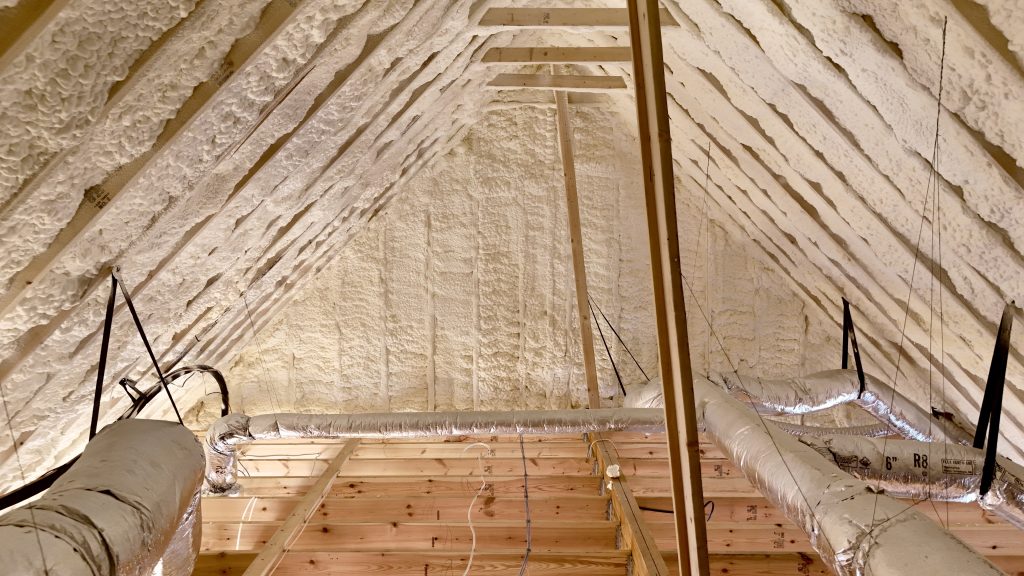
For suitable unvented attic assemblies, spray foam can be installed along the underside of the roof deck. This approach moves the insulation and air-control layer closer to the roofline. It may also help bring attic equipment and ductwork within the building’s conditioned space.
The foam type and installation thickness must be selected based on the roof assembly, climate requirements, and applicable building codes.
In buildings with vented attics, insulation may be installed across the attic floor to separate the conditioned space below from the unconditioned attic above.
Spray foam can help seal gaps around framing, wiring penetrations, and other openings before or as part of the insulation work. The attic ventilation strategy must remain appropriate for the assembly, and existing insulation may need to be evaluated before installation.
Commercial attic spaces can contain rafters, trusses, framing connections, and hard-to-reach cavities. These areas can create gaps where conditioned air escapes or outside air enters.
Spray foam expands to fill suitable openings and spaces around the framing. This can create a more continuous insulation and air-control layer when installed as part of a properly designed assembly.
Some commercial buildings have HVAC ducts, air handlers, or other mechanical equipment located in the attic. When these components are exposed to extreme attic temperatures, the HVAC system may have to work harder to maintain indoor comfort.
In certain building designs, insulating at the roofline can bring these components inside the conditioned building enclosure. The right approach depends on the existing HVAC layout, ventilation requirements, and roof assembly.
Attic insulation can benefit different types of commercial properties, including offices, retail spaces, and buildings with attic areas above occupied rooms.
We evaluate the building’s layout, roof construction, and insulation needs to determine the appropriate application. The goal is to address the areas contributing to unwanted heat transfer and air leakage without overlooking ventilation or moisture concerns.
Attic insulation helps create a more effective barrier between the roof and the occupied areas of your commercial property. When properly selected and installed, spray foam can provide several practical benefits.
An inadequately insulated attic can allow outdoor heat to affect the rooms below. Spray foam helps slow heat transfer through suitable roof and ceiling assemblies, making indoor temperatures easier to manage.
This can be especially useful during McDonough’s hot summers, when roof temperatures can rise significantly.
Small openings around framing, penetrations, and attic connections can allow conditioned air to escape. Spray foam expands into suitable gaps, helping create a more continuous air barrier.
Reducing unwanted air movement can support more consistent indoor conditions.
When less heat enters or escapes through the attic, your heating and cooling equipment may have less work to do to maintain the desired temperature.
Actual energy savings depend on the building’s existing insulation, HVAC system, air leakage, operating schedule, and other factors.
Temperature differences between rooms can make commercial spaces less comfortable for employees, customers, and visitors.
A properly insulated attic can help reduce heat transfer between the roof and occupied areas, supporting more consistent indoor conditions throughout the building.
Open-cell spray foam has sound-absorbing properties that may help reduce some noise transmission through suitable attic and roof assemblies.
This can be useful for businesses that want to limit certain outside sounds, including noise from heavy rain. However, insulation alone does not soundproof a building.
An attic without adequate insulation can contribute to ongoing building performance problems. These issues may become more noticeable during periods of extreme heat or cooler weather.
Without sufficient insulation, heat can move more easily through the attic. During summer, unwanted heat may enter the building, while indoor heat can escape during colder weather.
This can increase the demand on your HVAC system and contribute to higher energy expenses.
Poor attic insulation can make upper floors or rooms directly beneath the roof harder to keep comfortable.
Employees and customers may notice hot spots, cold areas, or temperature changes throughout the day.
When conditioned air escapes and outdoor heat enters, heating and cooling equipment may need to run longer to maintain the thermostat setting.
Over time, this additional demand can affect system performance and operating costs.
Gaps around attic framing, ceiling penetrations, and other openings can allow outside air to enter and conditioned air to escape.
This may contribute to drafts, inconsistent temperatures, and reduced control over indoor conditions.
Differences in temperature and humidity can contribute to condensation within certain roof and attic assemblies. Poor insulation, air leakage, roof leaks, and inadequate moisture management can all play a role.
Moisture problems should be evaluated before insulation is installed. Applying spray foam over an existing leak or damp material does not resolve the underlying cause.
Choosing attic insulation for a commercial property involves more than selecting a product. The roof assembly, building use, existing insulation, and ventilation strategy all affect the recommendation.
Based in McDonough, GA, Georgia Insulation serves nearby communities with commercial insulation solutions tailored to local climate conditions, including hot, humid summers and seasonal temperature changes. Our recommendations are based on your building's specific needs.
We assess your attic's existing insulation and identify areas that may need additional insulation or air sealing. We then explain suitable spray foam options and why each application may be appropriate for your home.
We explain the proposed insulation work, areas covered, and project costs upfront. You receive a clear estimate and have the opportunity to review the recommendations and ask questions before proceeding.
We follow a practical process to understand your building’s needs and plan the insulation work.
We begin by reviewing the attic layout, roof construction, existing insulation, and accessible areas. We look for gaps, damaged materials, moisture concerns, and conditions that may affect installation.
After the inspection, we discuss whether open-cell or closed-cell spray foam is appropriate for the application. We consider the roof assembly, ventilation strategy, available space, and your building’s insulation goals.
We outline the proposed work, the areas to be insulated, and the expected project scope. We also discuss preparation requirements and scheduling so you know what to expect.
Before application, the work area must be prepared according to the installation requirements. Surfaces should be suitable for adhesion, and existing leaks, damp materials, or other underlying problems should be addressed.
We also follow the necessary precautions for protecting the surrounding areas.
The selected spray foam is applied to the approved attic areas at the planned thickness. Proper application helps create a consistent insulation layer while addressing suitable gaps and openings.
After application, we review the insulated areas and check that the work follows the agreed scope. Reentry and ventilation requirements are handled according to product manufacturer guidance and applicable safety recommendations.
We provide professional attic insulation services in McDonough, GA, and surrounding communities. Our team delivers tailored insulation solutions for homes and businesses to improve energy efficiency, control moisture, and maintain comfortable indoor temperatures year-round.
An inadequately insulated attic can make it harder to maintain comfortable indoor temperatures and manage energy use. Georgia Insulation provides spray foam attic insulation in McDonough, GA, and surrounding areas to help business owners address heat transfer and unwanted air movement.
Whether you need insulation for an office, retail property, warehouse, or another commercial building, we can review your attic and discuss an approach suited to its construction. Contact Georgia Insulation today to request an estimate and take the next step toward better building performance.
The cost depends on attic size, accessibility, existing insulation, selected spray foam, and the thickness required. We review these details before preparing an estimate.
Open-cell and closed-cell spray foam can both be suitable, depending on the roof assembly and building requirements. We assess the space before recommending an option.
It depends on the condition and type of existing insulation. Damaged, wet, or unsuitable materials may need to be addressed or removed before installation.
Proper insulation can help reduce unwanted heat transfer and HVAC demand. Actual savings depend on the building’s condition, equipment, air leakage, and operating schedule.
Yes, spray foam may be installed along the underside of a roof deck in suitable assemblies. The application must account for ventilation, moisture management, and applicable building requirements.
Insulation and air sealing can help manage conditions that contribute to condensation, but they do not guarantee that condensation will not occur. Roof leaks, humidity, ventilation, and assembly design must also be considered.