
Metal buildings gain and lose heat quickly, and steel surfaces collect condensation when warm, humid air meets a cold panel. Metal building insulation in Monroe, GA controls temperature swings, reduces condensation, and lowers the energy needed to heat and cool warehouses, shops, retail spaces, and storage buildings. Without it, interior conditions follow the weather outside.
At Georgia Insulation, we install spray foam and other insulation systems in commercial metal buildings for business owners in Monroe and the surrounding areas. Spray foam bonds directly to roof and wall panels, which seals air leaks and limits the moisture problems that lead to rust and damaged inventory.
On this page, we cover where insulation goes in a metal building, the benefits you can expect, and the risks of leaving a building uninsulated. We also explain our installation process and answer common questions so you can decide what fits your building and budget.
The best insulation for a metal building depends on the foam type, the surface it bonds to, and how much R-value the building needs. We match each of these to how you use the space, the local climate, and your budget.
Closed-cell spray foam is our usual recommendation for exposed metal roofs and walls. It bonds directly to steel panels, which removes the air gaps where condensation forms.
It delivers roughly R-6 to R-7 per inch, so it reaches a high R-value without taking up much depth. It also acts as a vapor retarder and adds rigidity to thin metal panels.
Closed-cell foam works well in these areas:
In Georgia, where summer heat and humidity are both high, this combination of insulation and moisture resistance suits most metal buildings.
Get a Free QuoteOpen-cell spray foam has a softer structure and delivers about R-3.5 to R-4 per inch. It costs less per inch than closed-cell foam and works well where moisture exposure is low.
We consider it for interior walls, ceilings below a conditioned attic space, and office or retail build-outs inside a larger metal structure. It also provides good sound absorption, which helps in offices, meeting rooms, and break areas.
We do not recommend open-cell foam directly against bare metal roof or wall panels in most cases. It is vapor permeable, so moisture can pass through it and reach cold steel surfaces.
| Feature | Closed-Cell | Open-Cell |
|---|---|---|
| R-value per inch | About R-6 to R-7 | About R-3.5 to R-4 |
| Moisture resistance | High | Low |
| Sound absorption | Moderate | High |
| Best placement | Metal roofs and walls | Interior assemblies |
The right thickness comes from the R-value your building needs, not from a single standard depth. Several factors set that target.
We review these points during the site assessment and give you a written recommendation for each area of the building.
Get a Free QuoteSpray foam works on roof undersides, wall cavities, interior partitions, attics, and crawl spaces. The right placement and foam type depend on the building’s use, its climate exposure, and how the structure handles moisture and temperature.
Metal roofs and wall panels are the most common starting point for our work. Steel conducts heat quickly, so the underside of a roof deck can reach the dew point and drip condensation onto stored goods, equipment, and floors.
We spray closed-cell foam directly to the underside of roof panels and the inside face of wall panels. The foam bonds to the metal, fills the gaps around purlins and girts, and creates a continuous air and vapor barrier. This addresses condensation at the surface where it forms.
Typical application points include:
A thickness of 2 to 3 inches suits many Georgia buildings, though we confirm the target R-value during the site assessment.
Large open buildings lose conditioned air through roof panels, wall seams, and overhead doors. Spray foam reduces that loss and helps hold a more stable temperature for the people and inventory inside.
In warehouses and workshops, we focus on the building envelope rather than interior surfaces. Closed-cell foam on the roof and walls limits temperature swings that can cause rust on tools, warp materials, or spoil sensitive products. Open-cell foam is less common here because it does not block moisture as well.
We also treat the areas that leak most often:
If you store food, chemicals, or electronics, tell us in advance so we can plan foam type and thickness around those conditions.
Many metal buildings include a finished office, break room, or showroom within a larger shell. These interior spaces benefit from insulation that controls both temperature and sound.
For framed office walls, we can use open-cell foam, which costs less per board foot and helps dampen noise between rooms. For exterior-facing walls and ceilings where moisture is a concern, closed-cell foam gives stronger vapor resistance and higher R-value per inch.
Common interior applications include:
Sealing these areas lets your HVAC system run less often and keeps the workspace comfortable year-round.
Many of our business clients also own homes or rental properties, and we apply the same products there. Attics, crawl spaces, and attached garages are the areas where air leakage and moisture most often cause problems.
In attics, we spray the underside of the roof deck so the attic becomes part of the conditioned envelope. In crawl spaces, we apply foam to the walls and rim joists to limit humidity and drafts rising into living areas. Garages receive foam on shared walls and ceilings below finished rooms.
Closed-cell foam suits crawl spaces and any area prone to moisture. Open-cell foam works well for attic roof decks in dry conditions. We recommend the option that fits each location rather than using one product everywhere.
Insulating a metal building lowers heating and cooling costs, keeps indoor temperatures steadier, and controls the moisture that causes rust and damage. Each of these gains protects both your operating budget and the structure itself.
Steel conducts heat quickly. In summer, a bare metal roof absorbs solar heat and passes it straight into the space below, and in winter the same panels pull warmth out just as fast.
Closed-cell spray foam applied to the underside of roof and wall panels adds insulating value and covers the framing and fasteners, which are common paths for heat loss. Because the foam bonds directly to the metal, it leaves no gaps behind the insulation layer.
With less heat moving through the shell, your heating and cooling equipment runs shorter cycles. That can mean:
Actual savings depend on building size, climate, and use, so we assess each structure before recommending an R-value.
Uninsulated metal buildings often swing between hot afternoons and cold mornings. Workers near the walls or under the roof feel these shifts most.
Spray foam reduces those swings, so your team works in a space that stays closer to the thermostat setting. That supports comfort and focus, particularly in shops, warehouses, and manufacturing floors where staff spend full shifts indoors.
Stable temperatures also matter for what you store and produce. Consider these examples:
Insulation will not replace climate control where precise conditions are required, but it makes those systems easier to maintain.
Metal buildings are prone to condensation. Warm, humid indoor air meets cold steel, and moisture forms on the panels and drips onto floors, stock, and equipment.
Closed-cell spray foam seals air leaks and creates a barrier that keeps humid air from reaching the cold metal surface. This limits the moisture that leads to:
Sealing gaps around panel seams, eaves, and penetrations also keeps out dust, pests, and unconditioned air. A tighter shell helps your HVAC system hold temperature and humidity levels more reliably.
Steel walls and roofs move heat and moisture quickly, which affects comfort, equipment, and operating costs. Without insulation, a metal building tends to show these problems within the first full year of use.
Metal conducts heat far faster than wood or masonry. In Georgia summers, a bare steel roof exposed to direct sun can reach surface temperatures well above the outdoor air temperature, and that heat radiates straight into the workspace.
In winter, the same panels pull warmth out of the building. Heaters run longer, and the space still feels cold near walls and overhead doors.
Here is how this typically shows up for business owners:
Undersized or overworked HVAC equipment also wears out sooner when it has to fight constant heat transfer.
When warm, humid indoor air touches a cold metal surface, water vapor turns into liquid. This is the same process that causes drops to form on a cold glass of tea. In a metal building, it happens on the underside of roof panels and along the walls, often overnight when panel temperatures drop.
The water drips or runs down the panels and collects at fasteners, seams, and framing connections. Repeated wetting can lead to surface rust, deteriorating coatings, and weakened fastener points over time.
Condensation also creates conditions for mold and mildew on any organic material nearby, such as wood pallets, cardboard, or drywall partitions.
Insulation with a proper vapor barrier keeps indoor air from reaching the cold metal surface, which addresses the cause instead of the symptom.
Dripping condensation does not stay on the roof panels. It lands on whatever is stored below, including stock, machinery, tools, and electronics.
The effects depend on what you keep inside:
Item stored | Common moisture problem |
Paper, cardboard, and packaging | Warping, staining, and mold growth |
Metal parts and tools | Surface rust and pitting |
Electronics and control panels | Short circuits and component failure |
Food-grade or sensitive goods | Spoilage and compliance concerns |
Vehicles and machinery | Corrosion on exposed components |
Damaged inventory means direct financial loss, and insurance coverage for gradual moisture damage is often limited. Humid air that stays trapped inside can also leave a persistent musty odor that affects customers and employees.
Controlling temperature swings and surface condensation reduces these losses and protects the equipment you rely on every day.
Our team works from Monroe, GA, and matches insulation systems to how each building is used. We also schedule installation around your daily operations so work does not interfere with your business.
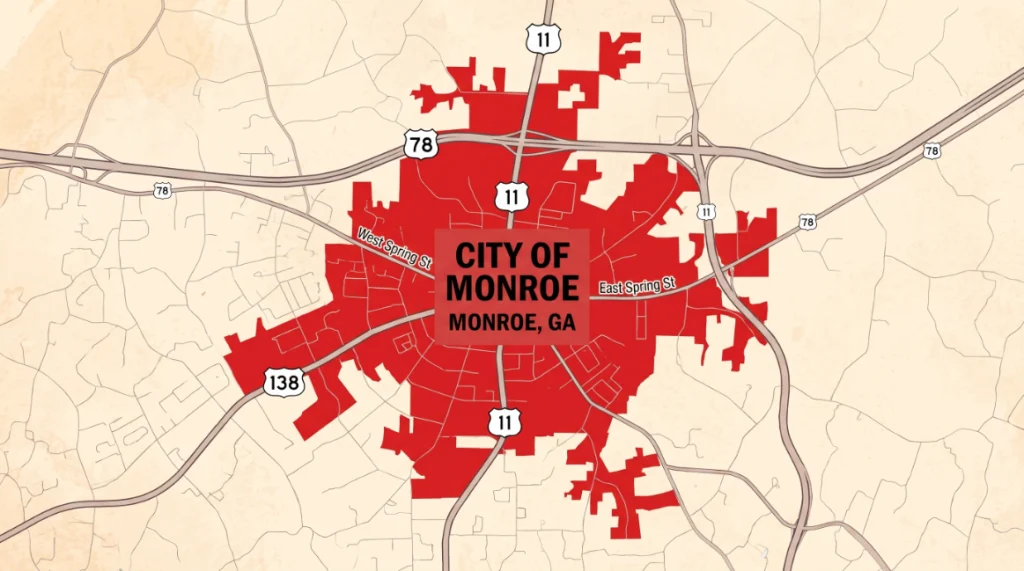
Based in Monroe, GA, we serve Walton County and surrounding communities with insulation solutions for warehouses, workshops, agricultural buildings, retail spaces, and other commercial properties. Our local team understands Georgia's humidity and condensation concerns in metal structures, providing convenient site visits, measurements, and follow-up support.
We evaluate each building's temperature requirements, moisture exposure, noise levels, budget, and project timeline before recommending spray foam, fiberglass blanket systems, or a combination. We explain the expected R-value, costs, and trade-offs so you can choose an insulation solution that fits your building and needs.
We plan insulation work around your operating schedule to minimize downtime and disruptions. Our team coordinates work areas, access points, and timelines, with options for phased, evening, or weekend installations. We also communicate spray foam curing and ventilation requirements in advance, protect nearby equipment and inventory, and clean up after the project.
Every metal building project starts with a measured look at the structure, then moves through moisture testing, surface preparation, and controlled spray foam application. The work ends with an inspection and a clear schedule for when the space can be used again.
We begin with a walkthrough of your building, usually at no charge for commercial properties in Monroe and the surrounding area. During the visit we record the roof and wall panel type, the building’s dimensions, and the framing style, whether I-beam or tube.
We also look for existing insulation, signs of condensation, rust, roof leaks, and any areas where equipment or stored inventory will need to be moved.
Your estimate is based on several measurable factors:
We put the scope, material, and timeline in writing so you can compare it with other bids.
Spray foam bonds to clean, dry steel, so preparation determines how well the finished insulation performs. We remove dust, loose debris, oil, and flaking paint from the panels, and we treat surface rust where it is present.
Moisture is checked before any foam goes on. We use a moisture meter and, where needed, an infrared camera to find damp spots, and we confirm that the panel temperature is above the dew point.
Active roof leaks and failed fasteners are repaired first, since foam applied over a leak traps water against the metal.
Typical preparation steps:
We apply the foam in thin passes, letting each layer expand and cure before the next. Most commercial metal buildings are sprayed at 1 to 3 inches for closed-cell foam, with thickness set by your target R-value.
Closed-cell foam adds roughly R-6 to R-7 per inch and works as a vapor barrier. Open-cell foam is lighter and less costly, but it does not block moisture as well.
Building codes require a protective layer over exposed spray foam in many commercial settings. Depending on the occupancy and local code, this can be a thermal barrier such as 1/2-inch gypsum board, or an intumescent coating rated for the foam in use.
Our crew wears respirators and protective suits, and we seal off work zones so overspray stays out of areas that are not being treated.
After spraying, we measure foam thickness at multiple points and check for gaps, voids, and uneven coverage. Any thin spots are corrected before we leave.
During the work, we run ventilation equipment to move air out of the building. Foam also needs time to cure, and the length of that time depends on the product used and the weather conditions.
General reoccupancy guidance:
Area | Typical wait before return |
Work zone | Follow the manufacturer’s stated re-entry time, often 12 to 24 hours |
Adjacent spaces | Usually available once ventilation is complete |
We give you the exact time based on the specific foam we install, and we leave you with product data sheets and the final thickness records for your files.
We provide metal building insulation services in Monroe, GA, and surrounding areas, helping businesses improve energy efficiency, control indoor temperatures, and reduce moisture-related issues. From warehouses and agricultural buildings to commercial and industrial facilities, we tailor insulation solutions to your building’s needs and Georgia’s climate.
We schedule consultations promptly and work around your business hours to minimize disruption to daily operations.
Insulation choice, cost, condensation control, code requirements, installation logistics, and service area are the questions business owners ask us most about metal buildings. The answers below reflect typical conditions for commercial and agricultural steel structures in Georgia.
The best option depends on how you use the building, your budget, and your climate. For most conditioned commercial spaces in Georgia, we recommend closed-cell spray foam because it insulates, air seals, and acts as a vapor barrier in a single application.
Fiberglass blanket with a vapor-barrier facing is a lower-cost alternative. It works well for warehouses and storage buildings where tight temperature control is less critical. Reflective barriers can help in buildings that mainly need to reduce radiant heat gain.
A 40×60 building has 2,400 square feet of floor area, but the insulated surface includes the roof and walls, which can total roughly 4,500 to 5,500 square feet depending on eave height and roof pitch. Cost depends on the material, the R-value you choose, and the condition of the existing structure.
Fiberglass with a vapor barrier generally costs less per square foot than spray foam. Spray foam costs more upfront but often reduces energy use and maintenance over time. We provide free quotes based on your building’s actual dimensions and use.
Yes. Condensation forms when warm, humid air reaches the cool steel surface and turns to water. Closed-cell spray foam bonds directly to the metal and seals the surface, so humid air cannot reach it.
This matters in Georgia, where summer humidity is high. Dripping condensation can damage stored inventory, equipment, and floors, and it can contribute to rust on steel panels and fasteners. Spray foam is not the only solution, but it addresses air leakage and moisture in one step.
Georgia follows the International Energy Conservation Code with state amendments, and the required R-values depend on the climate zone and whether the building is conditioned. Monroe and most of central Georgia fall in climate zone 3, while parts of north Georgia fall in zone 4.
Requirements also vary by building type and by the local jurisdiction that issues your permit. We recommend confirming the current requirements with your county building department or your design professional before you choose a system. We can help match an insulation package to the R-values your project needs.
In most cases, yes. Spray foam can be applied to the interior roof and wall surfaces of an occupied building, and we can schedule work in phases, after hours, or on weekends to limit interruption.
Some areas may need to be cleared or covered, and the space may need to stay unoccupied for a short period during and after application while the foam cures. We review your operations before we start so the schedule fits your workflow.
Yes. We are based in Monroe, and we also serve businesses in surrounding areas, including the Atlanta metro region, Gainesville, and communities across central and north Georgia.
If your building is outside those areas, contact us with the location and we will tell you whether we can take the project.